
Thursday, July 02, 2026 | Today's Newsletter | Login
Carney’s “Condo Bailout” for Developers Slammed
By Mata Press Service
Critics are warning that a new federal-provincial housing initiative in British Columbia risks bailing out developers and speculators rather than tackling the root causes of Metro Vancouver’s housing crisis.
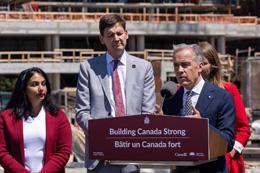
At a June 18 news conference in Vancouver, Prime Minister Mark Carney and BC Premier David Eby announced a 10-year partnership that will see Ottawa spend more than $5 billion on housing, transit and related infrastructure through the Build Communities Strong Fund.
The plan includes using the new Build Canada Homes agency to help convert more than 2,200 vacant condominium units into affordable housing, which the Prime Minister’s Office has called one of the fastest ways to increase supply.
New Democrat housing critic Jenny Kwan, MP for Vancouver East, is calling on the federal government to drop what she describes as a “developer bailout” that offloads empty condos onto the public balance sheet.
In a recent statement, she argued the program “rewards developers and speculators for their bad bets” instead of directing money to non-profit providers, co-ops and deeply affordable housing for people most at risk.
Conservative Leader Pierre Poilievre has also condemned the initiative, saying public funds should not be used to absorb inventory from projects built during a hotter market and now sitting unsold.
The criticism comes as unsold inventory in Metro Vancouver hits multi-decade highs. According to the Canada Mortgage and Housing Corporation (CMHC), completed but unsold homes and condos in the region reached 6,149 in May 2026, with condo apartments making up the bulk of that stock and rising 76 per cent from the same time last year.
These units are concentrated in areas including Richmond, the Tri-Cities and Central Park/Metrotown.
“Part of the reason unsold inventories have risen is due to the recent influx of supply,” said CMHC economist Michael Mak, noting that a surge of projects started in the early 2020s has now reached completion. Over the past 35 years, Metro Vancouver saw its highest number of condo completions in 2025.
Developers bought land and financed projects based on 2022 market conditions — low interest rates, high immigration and expectations of rising rents and condo prices — but that environment has shifted, said Thomas Davidoff, director of UBC’s Centre for Urban Economics and Real Estate.
Higher borrowing costs, slower population growth and weaker presale demand have left some builders with finished units they cannot sell. “People take chances in business. They have to be open to taking losses when those bets go wrong,” Davidoff said.
Demand has also softened, Mak said. Mortgage rates are limiting what buyers can afford, while economic uncertainty and elevated unemployment are causing some households to delay purchases. Higher rental vacancies, slower rent growth and more purpose-built rental supply have made condos less attractive to investors who would normally buy units to rent out.
Economist Tsur Somerville of UBC’s Sauder School of Business said the condo conversion plan could both support a weak market and put already-built homes to use, but only if governments can buy units cheaply enough. If Ottawa and BC can purchase multiple units in bulk at prices below the cost of building new affordable housing, “the idea could have merit,” he said. “But if all you’re going to do is buy a lot of stuff at a list price that people can’t sell, that looks very lousy.”
Kwan has questioned whether the government can credibly claim the units will be “affordable” without clear benchmarks tying prices or rents to income levels. She has urged Ottawa to shift focus toward permanently affordable models such as non-market rentals, co-op housing and acquisitions of existing older buildings where lower costs could reach people in core housing need.
Davidoff said the greater risk may lie with lenders rather than developers. If builders cannot repay loans, banks and other lenders could be exposed, which may ripple through the broader economy and make financing future housing construction more difficult.
“If banks are short of capital, we’re in big trouble,” he said. Leaving unsold condos on the market could push prices down and help some buyers, he added, but a sharper drop could prompt developers to cancel new projects, setting up another supply shortage later. “If things don’t sell, nothing moves,” Somerville said. “Prices crash and then nobody starts building anything for 10 years.”
CMHC expects new home construction to fall in coming years as weak new-home sales and presale demand make it harder for condo projects to go ahead, Mak said. In an email, Housing, Infrastructure and Communities Canada said Build Canada Homes will act as a funding partner in the condo conversion partnership, aiming to secure below-market units through bulk purchasing, but noted that funding requirements and delivery details are still being finalized.
The program is also raising questions about how limited housing dollars should be used. Brand-new condos are among the most expensive forms of housing to subsidize and offering them at deep discounts may help only a relatively small number of households, Davidoff said.
Governments should be explicit about who the homes are meant to serve, he added: helping a teacher or firefighter rent a new condo below market is not the same as helping someone sleeping in a car or coping with addiction.
Davidoff suggested governments could treat the condos as public investments: if they can buy units cheaply, rent them out and cover their costs, any surplus could be directed toward people with deeper housing needs, including those who require addiction support or direct cash assistance because they are sleeping in vehicles or staying temporarily with relatives. “You don’t do redistribution to people in need by getting them brand new condo units,” he said.
A spokesperson for BC’s Ministry of Housing and Municipal Affairs said many British Columbians — including young people and families — earn good incomes but still feel locked out of home ownership because they cannot save enough for a down payment. Discussions are underway with the federal government and stakeholders on how to use new financing tools to create a pathway to ownership, with more details to come.
Even if governments can secure units at a discount, ongoing costs could erode affordability, said Tony Gioventu, executive director of the Condominium Homeowners Association of BC. Public or non-profit owners would still have to pay monthly strata fees, insurance, property taxes, repairs and possible special levies, just like any other condo owner — costs that could affect whether units remain affordable over time. “It can enable more housing, but not affordable housing,” he said.
Gioventu noted that similar mixed-housing models already exist in BC, including developments where non-profit or social housing operates alongside market condos. Those arrangements can work, he said, but only when housing providers understand the building’s rules, shared costs and long-term repair obligations before they buy. “The devil in the details still stands,” Gioventu said. “In concept, it’s a great idea… The details of how this looks just need to be worked out.” – with files from Sonal Gupta, Local Journalism Initiative Reporter
Leave a comment