
Wednesday, August 19, 2026 | Today's Newsletter | Login
Bhangra academy now offers high school credits
By Aisha Chaudhry
Local Journalism Initiative Reporter
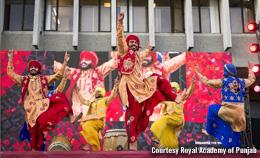
Students at the Royal Academy of Punjab can now earn high school credits while learning Punjabi folk dance.
The school received news in July that it had been approved by the provincial Ministry of Education and Child Care to offer Grade 10, 11 and 12 external credits for bhangra. Established in 2012, the academy has locations in Surrey, Edmonton and Calgary.
Hardeep Sahota — the academy’s general manager who oversees overall operations and programming — explained a large part of his job is developing new education opportunities for students.
The process of getting the program approved required a “tremendous amount of research, curriculum development, documentation and attention to educational standards,” said Sahota.
The challenge Sahota faced was how to take such a large and rich body of knowledge and structure it into a curriculum without losing authenticity — especially as Punjabi folk arts are usually passed down through oral traditions, community celebrations and families.
“For me, the work is ultimately about creating a bridge between generations — preserving the knowledge and traditions that came before us while making them relevant and accessible to young people growing up in Canada,” he said.
Sahota wants students to understand the rhythms, clothing, traditions and history behind the performances. He said the curriculum is designed to teach Punjabi folk arts as a complete cultural and artistic tradition and not just choreography.
“One thing that was extremely important to us was that this could not simply be a dance class receiving school credit. We wanted the curriculum to genuinely educate students about Punjabi folk arts,” said Sahota.
Students will have the chance to learn about Punjabi folk traditions, regional variations, traditional music, instruments and the role folk arts have played in Punjabi social and cultural life.
“Our goal is that a student should not only know how to perform something. They should understand what they are performing, where it comes from and why it matters.”
When hearing the news last month, Sahota was excited that youth in B.C. would have an opportunity to connect with their culture and heritage while also receiving recognition of its educational value.
“It was a very emotional and proud moment for me and for everyone who contributed to developing the program. It felt like much more than receiving approval for a course. To me, it represented recognition that Punjabi folk arts, and the knowledge and traditions behind them, have educational value and deserve to be studied seriously,” he said.
The community response has also been encouraging. Many parents are keen to ensure their children continue to connect to Punjabi culture while growing up in Canada. Sahota said young people have also been excited, showing that cultural learning and academic achievement do not have to be two separate paths
Sahota hopes students can study Punjabi folk arts with the same seriousness as other subjects — that students learn and develop skills, grow as performers and feel confident in their heritage.
“Punjabi folk arts carry history … When we teach these traditions properly, we are not simply teaching young people how to dance. We are giving them access to knowledge that generations before them carried and passed forward.”
The academy is currently introducing the program to students and families and moving through the enrolment process.
Despite this achievement, Sahota said the ministerial approval is not the end of their journey. “Now our responsibility is to deliver a program that meets a high educational standard while remaining authentic to the traditions and cultural knowledge we are teaching.”
Leave a comment