
Thursday, April 23, 2026 | Today's Newsletter | Login
Canada has a Second Chance to Fuel the World
By Don MacLachlan
Resource Works
Soaring prices and a shortage of LNG due to the Iran war sparked a flurry of hopes that Canada could provide more to countries running short.
LNG Canada reports receiving numerous calls from Asian buyers, but “all of our LNG is spoken for.”
While Canadian and US LNG producers would love to help those deprived of Qatar’s LNG, neither country now has the capacity to do so. Both do, though, see new potential customers down the road.
And TC Energy CEO François Poirier says the disruption to global LNG supplies caused by the Iran war makes it more likely that LNG Canada’s massive facility in BC will be expanded.
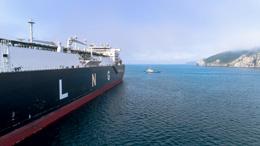
LNG Canada seems to be on the verge of announcing such plans for expansion, to double output to 28 million tonnes a year.
It has just signed up a firm for front-end engineering design, and has a new agreement with Coastal GasLink that covers doubling the transmission of natural gas through the existing Coastal GasLink pipeline.
Dane Gregoris, energy director at Enverus Intelligence Research, is optimistic about a “second wave” of Canadian LNG projects over time. He has suggested there could be as many as six new LNG projects.
As of now, Iranian missile attacks on Qatar’s Ras Laffan LNG complex, the world’s largest LNG export plant, have knocked out 17% of Qatar’s LNG export capacity and repairs are expected to take three to five years.
It could take that long to acquire the big gas turbines required to power LNG refrigeration compressors, as they are in seriously short supply and orders are long backlogged. That could also affect planned or proposed Canadian and US LNG plants down the road.
Analysts at Rystad Energy say estimates to fix war damage to gas, LNG and oil facilities run to at least $25 billion, and very possibly more.
While the US is the world’s largest exporter, Qatar is second. Its Ras Laffan facility accounted for 19% of global LNG exports in 2025, and its cargoes supplied more than one-fifth of total gas consumption in India, Taiwan and Pakistan. Buyers such as South Korea and Singapore are also vulnerable.
The immediate shortage of Qatar LNG was also followed by the temporary closure, due to a cyclone, of some Australian LNG export plants, threatening 8% of world LNG supply.
India, for one, now is looking at importing more LNG from Russia. Japan and some others are considering ramping up coal-fired power generation as the LNG crunch has led to significantly higher prices. And those prices are set to crash China’s LNG imports to an eight-year low.
The spot price of LNG stood at US$10.72 for one million British Thermal Units on Day One of the war. After the news from Qatar, it hit US$20 and market-watchers say LNG could move above US$26 in the coming weeks, with some analysts warning of prices above US$30 or even US$40 if LNG-carrier traffic through the Strait of Hormuz remains disrupted by Iran for months.
Natural gas powers a quarter of the world, and almost a fifth of LNG moves through the Strait of Hormuz.
In Canada, Natural Resources Minister Tim Hodgson has several times declared that German companies are interested in Canadian LNG.
He has said buyers are prepared to use the West Coast to serve German needs, but more recently has said Canada could ship more natural gas to the US Gulf Coast, where the Americans would turn it into US LNG for export.
That was what Justin Trudeau as prime minister proposed, back in 2022, instead of direct LNG shipments from Canada’s East Coast to Germany.
Canadian gas exports have indeed been happening via the US. Canada now ships some 8 billion cubic feet per day of natural gas to the US. A significant portion of this goes to the US Gulf Coast to be turned into LNG, and exported by the US — at a nice profit to US operators.
Meanwhile, the heat is on Ottawa to speed up its ponderous regulatory processes for LNG and other natural-resource developments.
As billed by Prime Minister Mark Carney, the federal Major Projects Office (MPO) was set up last summer “to get nation-building projects built faster.”
In Carney’s words; “The MPO will accelerate projects by creating a single set of conditions, thereby reducing the approval timeline for projects of national interest to a maximum of two years.” That compares with five or more years for some complex Canadian projects, and as long as 15 years for one mining project.
Among 17 projects referred to the MPO are the probable expansion of LNG Canada in BC, the Nisga’a Nation’s Ksi Lisims LNG project in BC, and three phases of BC Hydro’s North Coast Transmission Line, which will feed LNG and other resource developments.
Is the MPO succeeding in the acceleration? Who knows? There have been no reports from the MPO on its speed-up progress on any of the 17 projects.
TC Energy‘s François Poirier, for one, has said that shorter approval timelines would make Canada far more competitive, especially as buyers look for supply that avoids chokepoints such as the Strait of Hormuz.
And Dane Gregoris of Enverus Intelligence Research, tells us how Canada has lagged in LNG development because of regulatory uncertainty and permitting issues.
He says such delays extended timelines and drove capital providers toward the U.S. market instead. “Capital moves pretty freely. If you have an uncertain regulatory path, capital moves quickly.”
Gregoris’s optimism about a “second wave” of half a dozen new Canadian LNG projects stems from Western Canada’s geographic position. Shipping LNG from Kitimat to Japan takes about 10 days, compared to 25 days from the U.S. Gulf Coast.
This cuts shipping costs nearly in half. It also provides a significant price benefit for Canadian exports, with charter rates for LNG carriers sometimes running as high as $300,000 a day.
As an environmental bonus, the shorter LNG route to Asian ports also means less emissions from the LNG carriers.
The Asia Pacific Foundation of Canada says: “As Asia assesses its energy security amid the geopolitical turbulence . . . Canada offers a safe and reliable source of gas and LNG. Canada has what Asia needs: oil and gas that transit no contested straits, originating from a trusted trade partner beyond drone range”.
The stakes for the Canadian economy are high. Gregoris suggests Canada could jump from exporting two billion cubic feet a day to 20 billion by 2040. This would provide a massive increase in government revenue through royalties.
It would also, Gregoris says, create thousands of jobs to build the necessary infrastructure. “It would be a huge boon.”
Don MacLachlan is a writer for Resource Works, a non-partisan organization that champions responsible resource development in British Columbia and Canada.
Leave a comment